

Richard Strauss published few song collections that we could call cycles. Speaking from memory and therefore without being exhaustive, I would mention Mädchenblumen, Drei Lieder der Ophelia, and Krämerspiegel. Three works, by the way, that are rarely performed beyond a few isolated songs.
On the other hand, there are collections that, although they do not really fit the definition of a cycle –which is, in any case, always ambiguous– are often performed complete. The clearest example is probably the Four Last Songs, which tradition has unequivocally established as a cycle.
Another case is Op. 27, simply titled Vier Lieder, the four songs that Strauss gave on 10 September 1894, the day of his wedding, to his wife, the soprano Pauline de Ahna. All four, taken separately, are among the composer’s finest works and have rightly become well known. We are talking about Morgen, which would appear very, very high on the list of favourites if we surveyed music lovers, and Cäcilie, Ruhe, meine Seele, and Heimliche Aufforderung. Probably because both performers and audiences are very fond of them, it is not unusual to hear them together in a recital, as if they were a cycle.
Here at Liederabend, we still had pending the third one, Heimliche Aufforderung [Secret Invitation], which will be this week’s song. The poem and the song speak of the complicity between two lovers in the middle of a lively party. People separate them, but they only need to look at each other to know they are together; they wink at each other and raise their glasses. At some point during the evening they will slip away from the salons and meet in the garden, to be alone and love each other.
Strauss’s music speaks, in the first part, of the anticipation of the private meeting, while people surround them, unaware of their glances, with four stanzas framed by the glass that is raised joyfully, reflecting the lights of the party (“hebe die funkelnde Schale” in the first, “hebe die blinkende Schale” in the fourth). When the poetic voice invites the lover to the rendezvous in the garden, the music becomes intimate and tender, until it reaches the exultant final two lines, the climax of the song.
The name of the author of the verses, John Henry Mackay, does not sound very German, does it? He was the son of a Scotsman and a German woman, and was born in Scotland in 1864, the same year as Strauss. When the child was a year and a half old, his father died, and his mother returned to Germany, where she raised him. The family’s comfortable situation allowed the young man, once an adult, not to worry about working to make a living and to devote himself exclusively to writing.
The poem of Heimliche Aufforderung, as well as that of Morgen, was published in 1890 in the collection Das starke Jahr, Mackay’s third book of poetry, and Strauss set both to music on consecutive days in May 1894. It was in those years that the poet and the composer met and became friends, both interested in the theories of the philosopher Max Stirner on anarcho-egoism. For a time this was Mackay’s main area of work, but after his mother’s death in 1902 he devoted his energies to a much more personal and risky issue: the defence of homosexuality, which he called namelose Liebe [nameless love], as a legitimate option.
He did so anonymously, and today this may seem contradictory, but the times allowed little else; the threat of prison –with the terrible case of Oscar Wilde very present– was constant. Under the pseudonym Sagitta, Mackay clandestinely published, taking great risks, a collection of books that openly defended what in his earlier publications, such as the poems of Heimliche Aufforderung and Morgen, he had concealed. Unfortunately, his advocacy went beyond free relationships between adults and had a darker side: relationships with adolescents.
Here we could return to the question of whether one can separate an artist’s life from their work, but I prefer to stay, directly, with the song. Heimliche Aufforderung is one of those Strauss lieder that, although many women sing it very well, I find more fitting when sung by a male voice. For example, that of the great Fritz Wunderlich, who recorded it in November 1962 with pianist Rolf Reinhardt at the studios of the public broadcaster of southwest Germany, SWR; this is the version we will listen to this week. The tenor recorded the song again a few weeks later, in December; this time it was the orchestral version made by Robert Heger in 1929 with Strauss’s approval. Shortly afterwards, in early 1963, the tenor began his professional relationship with pianist Hubert Giesen, which would mark his definitive consecration as a lieder singer.
Tomorrow, Thursday 17 September, it will be sixty years since the death of Fritz Wunderlich, a few days before turning thirty-six. As every year, at Liederabend we remember him and thank him for so much wonderful music.
Auf, hebe die funkelnde Schale
empor zum Mund,
Und trinke beim Freudenmahle
dein Herz gesund.
Und wenn du sie hebst, so winke
mir heimlich zu,
Dann lächle ich, und dann trinke
ich still wie du...
Und still gleich mir betrachte
um uns das Heer
Der trunknen Schwätzer—verachte
sie nicht zu sehr.
Nein, hebe die blinkende Schale,
gefüllt mit Wein,
Und laß beim lärmenden Mahle
sie glücklich sein.
Doch hast du das Mahl genossen,
den Durst gestillt,
Dann verlasse der lauten Genossen
festfreudiges Bild,
Und wandle hinaus in den Garten
zum Rosenstrauch,—
Dort will ich dich dann erwarten
nach altem Brauch,
Und will an die Brust dir sinken
eh’ du’s gehofft,
Und deine Küsse trinken,
wie ehmals oft,
Und flechten in deine Haare
der Rose Pracht—
O komm, du wunderbare,
ersehnte Nacht!
Please follow this link if you need an English translation
Related articles
Autumn fever

My dearest, I am on holiday these days, so I am sending you a musical postcard, linked not to a place but to a voice, that of tenor Fritz Wunderlich. Yesterday marked fifty-eight years since his death at thirty-five, and next week will mark ninety-four of his birth. As every year, we dedicate a post on Liederabend to recall him and thank him for the music.
The neighbours
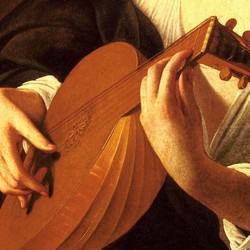
All the ingredients of a serenade are found in An die Laute [To the lute]: a warm, fragrant night with moonlight; a woman in her room, and a man beneath the window who wants to tell her his love. However, in the poem, the man does not address the woman, but instead his lute. The lute is the vehicle for the love message and it must be persuasive… and discreet. [...]
Evening prayer

As I told you last week, I'm on holiday; that's why you get again a postcard, that this time brings us the voice of Fritz Wunderlich. It was the anniversary of his death (56 years) a few days ago, and last Monday marked his birth (92 years); as every year, I would like to pay a small tribute to him.