
Hugo Wolf's great compositional moment arrived in 1888. In February of that year he began the Mörike-Lieder, and then came, one after another until 1891, the Eichendorff-Lieder, the Goethe-Lieder, the Spanisches Liederbuch, and the first part of the Italienisches Liederbuch. Afterwards he suffered a long and painful health and creative crisis, until he was able to write the opera Der Corregidor and, right after, in 1896, the second part of the Italienisches Liederbuch. He would still begin the opera Manuel Villegas and the Michelangelo-Lieder before a new health crisis prevented him in 1897, now definitively, from continuing to compose.
This is, in a few lines, a very schematic summary of Wolf's career, the well known, starting from that eruption, as he called it, of 1888. But what about before? What did Wolf do before he was twenty-eight years old? The catalogue of his works, the Hugo Wolf Werkverzeichnis, which orders them chronologically, assigns the reference HWW 118 to the Eichendorff-Lieder, the first collection he finished in 1888. That is to say, there are one hundred and seventeen previous catalogued works, starting from HWW 1, an incomplete piano sonata that he wrote in 1875. Broadly speaking, the first ten works are from that year, before going to study in Vienna; then come those from the couple of years he studied there at the Conservatory, and then those from his autodidactic period, searching for his own voice.
A good part of these works, which remained unpublished, are lieder. Every now and then I like to share one of them with you because, although these so-called early pieces do not have the strength of maturity, they do anticipate what was to come, and they also speak of his references. This week I propose that we listen to Die Nacht, HWW 89, composed on February 3, 1880.
After being expelled from the Vienna Conservatory in March 1877, Wolf returned for a time to Windischgrätz, to his parents' house, until at the end of the year he headed back to Vienna; that was where he could make a career as a composer. He was seventeen years old, highly talented, eager to take on the world, and blessed with good friends.
Among those friends was Adalbert von Goldschmidt, the son of a banker and, in principle, destined to dedicate himself to the family business. But, perhaps because he was the sixth child in the family and not essential at the bank, he was able to dedicate himself to what he wanted, poetry and music, without having to give up the privileges he enjoyed by birth. With Goldschmidt as his sponsor and with the help of his personal charm, Wolf frequented Viennese society, and that was how in the spring of 1878 he met Valentina Franck, the daughter of a university professor, with whom he fell in love with the intensity with which he did everything. Vally, as they called her, was four years older than him, and it seems she did not get as involved in the relationship, but she got involved enough for it to last three years, until March 1881. A few days before young Hugo turned twenty-one, Vally left him.
From a creative standpoint, that relationship was very productive; Wolf wrote a good handful of lieder inspired by Vally, among them Die Nacht. The breakup, in fact, was also productive; some time ago we listened here to Ergebung, one of the six choral songs with poems by Joseph von Eichendorff that he wrote a few days later.
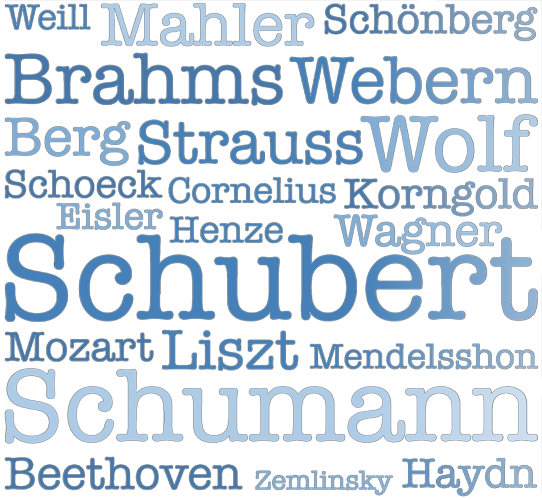
The poem of Die Nacht is also by Eichendorff, one of the poets Wolf frequented most during those years, along with Goethe, Heine, and Lenau (notice that all four were also very important for Robert Schumann). It is dated 1833, and it seems the writer would have included it in a preliminary version of the novel Dichter und ihre Gesellen (Poets and their Companions), published the following year. Finally it was published in a poetry collection with the title Die Nachtblume; I don't know if this "night flower" or "flower of the night" refers to any specific flower, because the verses do not speak of one.
The poem begins by saying "Nacht ist wie ein stilles Meer" [Night is like a quiet sea], and refers to the feelings, often opposed, that the night shelters; the joy and the suffering of loving meet there like waves when they break. Everything is quiet, but dreams also confuse themselves with thoughts, and this generates that restlessness, however slight it may be, that we know from other poems by Eichendorff. Wolf's music, always faithful to the poem, captures both this tranquil atmosphere, the waves succeeding one another quietly, and the uncertainty perceived by the poetic voice, the fear of not being able to control one's thoughts.
During the month of September 1888, Hugo Wolf composed thirteen lieder with poems by Eichendorff, added them to seven he had written previously, including Die Nacht, and published them. Die Nacht was well received, but its presence was brief: in the second edition –along with two other songs– it disappeared from the collection. The reason? The composer considered that it was not up to the standard of the rest, and that it resembled too closely the music Schumann had written for his Liederkreis with poems by Eichendorff. He described it as "unauthentisch" [unauthentic] and withdrew it.
Certainly, Die Nacht is very reminiscent of Schumann's music. Surely, if we listen to it a bit distracted, the first thing we will think is that it is his. But it is also a very beautiful song that I felt like proposing to you, and which we will listen to interpreted by Wolfgang Holzmair and Imogen Cooper.
Nacht ist wie ein stilles Meer,
Lust und Leid und Liebesklagen
Kommen so verworren her
In dem linden Wellenschlagen.
Wünsche wie die Wolken sind,
Schiffen durch die stillen Räume,
Wer erkennt im lauen Wind,
Ob’s Gedanken oder Träume? —
Schließ’ ich nun auch Herz und Mund,
Die so gern den Sternen klagen,
Leise doch im Herzensgrund
Bleibt das linde Wellenschlagen.
joy and sorrow and the laments of love
become tangled up
in the gentle throbbing of the waves.
Desires are like clouds
that sail through the quiet space:
who can recognize in the mild wind
whether they are thoughts or dreams?
Even if my heart and mouth now are closed,
that once so easily lamented to the stars,
still, at the bottom of my heart
there remains the gentle throbbing of those waves.
(translation by Emily Ezust)
Related articles
Greetings from...

Do you remember when we used to send postcards from our holiday destinations? No matter where we were, either in a faraway and exotic place or just in a village 40 km away from home. We chose a few images of the location and sat in a nice spot to drop a line to our friends. Well, whenever you read this post I will be on holiday and won't have any technical means to write and send you this musical postcard, so I’ll leave it ready and scheduled to be posted on Wednesday, and I'll trust the good working of bits as we used to trust our postmen...
I’ve chosen a beautiful musical clue of the place I’m going to. It doesn't exactly refer to the city but my intention is reaching this sea, so different from our Mediterranean. By the grace of Johannes Brahms and Karl von Lemcke on the one hand and Simon Keenlyside and Malcolm Martineau on the other, we can see on the postcard, called Verzagen (Despondency), a man sitting and gazing across the sea. A sea as hectic as disturbed his soul is. I hope that the landscape will bring him the peace he needs. And that's all...
Next week I'll be back home, and we'll commemorate together the great Fritz Wunderlich, as we do every year. Greetings from ...!
28 May 1925
The boy who would become our Dietrich Fischer-Dieskau was born in Berlin on May 28, 1925. And I say our without any intention of disrespecting him, rather it is the opposite. Fischer-Dieskau is a cultural heritage of Lied, just as many other things, material and immaterial, are a culture heritage of humanity.
Out in the skerries

I'm drawn to songs about the sea. Mainly because the sea is an essential part of my landscape. While many people find their greatest pleasure in the mountains (a modern version of waldeinsamkeit) you're far more likely to find me contemplating the sea. Fortunately, close to home. And when I travel, always seeking out other seas wherever I can.