

Without having planned it, this season has opened with a number of early works by teenage composers: Hugo Wolf’s Die Nacht, Reynaldo Hahn’s Chanson d’automne and George Crumb’s Night. This week we continue along these lines, with a song composed at the age of fourteen by Benjamin Britten.
Britten’s father was indifferent to music, while his mother was very fond of it and regularly hosted musical evenings at their home in Lowestoft, Suffolk, for friends and acquaintances. Of the four children she had, only the youngest, Benjamin, shared her love of music, and he soon began studying it: piano at the age of seven and viola at ten.
It was his viola teacher, Audrey Alston, a family friend who had been a professional performer before her marriage, who introduced the boy to orchestral music by taking him, in 1924, to a concert of the Norfolk and Norwich Festival conducted by the composer Frank Bridge, one of the most important figures in English music at the time. Until then, the boy would probably have heard little music other than chamber music, since his father would not allow a gramophone or a radio into the house under any circumstances.
Benjamin was captivated by that concert, and Alston encouraged him to compose. Three years later, at the next edition of the festival, the violist wanted Bridge, who was a friend of hers, to meet her pupil and see his first works. That meeting turned Britten into a pupil of Frank Bridge; once a week, the boy would travel to London to take lessons from him.
In the summer of 1928, during the holidays of that first year with Bridge, Britten composed a work as an anniversary gift for his parents: Quatre chansons françaises. That is, the boy had composed his first cycle (he had previously written a few isolated songs), and he had not composed it in his own language, but had chosen poems in French, a language he studied at school. What is more, they were not songs for voice and piano, but songs for voice and orchestra. His parents must have been astonished by the gift, music of remarkable solidity.
The work remained private and unpublished until its premiere in 1980, a little over three years after the composer’s death. The soprano Heather Harper, the English Chamber Orchestra and the conductor Steuart Bedford first gave a radio performance in March, and in June they presented it in concert at the Aldeburgh Festival. The Quatre chansons françaises were published two years later.
Of Britten’s four French songs, two set poems by Victor Hugo and two by Paul Verlaine. The last is Chanson d’automne, with that Verlaine poem we have heard twice recently: in Hahn’s version and, a little earlier, in Rita Strohl’s. I had kept Britten’s version to close this miniseries (for now, at least), and I invite you to listen to it performed by Ian Bostridge and the Britten Sinfonia, conducted by Daniel Harding.
Les sanglots longs
Des violons
De l'automne
Blessent mon cœur
D'une langueur
Monotone.
Tout suffocant
Et blême, quand
Sonne l'heure,
Je me souviens
Des jours anciens
Et je pleure;
Et je m'en vais
Au vent mauvais
Qui m'emporte
Deçà, delà,
Pareil à la
Feuille morte.
The long sobs
of autumn's
violins
wound my heart
with a monotonous
languor.
Suffocating
and pallid, when
the clock strikes,
I remember
the days long past
and I weep.
And I set off
n the rough wind
that carries me
hither and thither
like a dead
leaf.
(translation by Peter Low)
Articles relacionats
The Corn Poppy
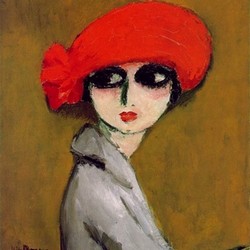
The Corn Poppy, the painting that illustrates this post, is an oil paint from 1919 by the Dutch painter Kees Van Dongen. It is not very large, 21 1/2 x 18 in, and it is part of the permanent collection of the Museum of Fine Arts in Houston. For some time, a friend of mine often had to travel to that city and fell in love with those big eyes and their innocent expression. I’ve only seen the painting through reproductions but my friend made me fall in love with it too, it became our painting. Sometimes, doesn't it happen that you share with a friend the love for a movie, a song, a picture, and whenever you see or listen to it, it reminds of him or her?
The last rose of summer
A few days ago, when I was finishing last week's article on Red Roses and Red Noses, I read a detail about the song that I had missed until then. On the booklet of "My Garden" (the CD from which I extracted the interpretation I shared), Richard Stokes said that Lord Berners' song was clearly a parody of Thomas Moore's song The Last Rose of Summer. I thought first I'd make [...]
Hate
A man is furious with his enemy. He doesn't say a word because he only talks to his friends. His anger grows, and he does nothing to avoid it, on the contrary: day by day, he nourishes it with his tears and his false smiles. Eventually, it bears fruit: an apple as appetizing as poisonous. Because hatred poisons whatever it touches. The man knows that his enemy will desire that apple. He won't wait long until he discovers, pleased, his corpse in the garden.
Songs often talk about love, sadness, hope, loneliness, peace, sometimes recount funny stories and more often, terrible dramas. We see ourselves reflected in these situations because we have experienced them, [...]