
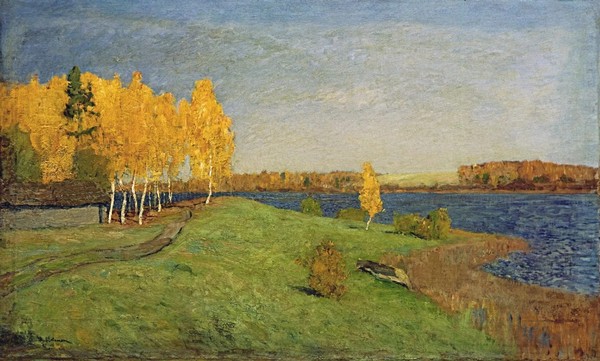
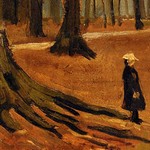
September has arrived, which means we are beginning a new season. It seems that the autumn has also arrived in Barcelona, which is quite unusual, since it usually arrives slowly and calmly. We wake up with pleasant temperatures, we enjoy a thin air, the sky is cloudy, and, when it clears, the sun's light is golden and soft. To celebrate, I bring you a short and beautiful poem by Eduard Mörike, Septembermorgen [September Morning], probably one of his best known. He wrote it in 1827, when he had just completed his training at the seminary in Tübingen. In just six verses, Mörike describes how the day begins: the fog that covers the sleeping world fades away, leaving a transparent blue sky, and the world begins its day with the sun and golden colors everywhere.
We're listening to two songs upon this poem, both by the same composer, Othmar Schoeck, a contemporary of other composers from Late Romanticism such as Joseph Marx, Max Reger or Ernest Bloch. Like all of them, his music is being recovered after being neglected from the second half of the 20th century.
Schoeck's first version of Sommermorgen was written in 1905; he was then nineteen and had just entered the Zurich Conservatory. After completing his education there, he studied composition for a year with Max Reger in Leipzig, and on his return in 1908, he made a name as a composer. This Sommermorgen is a charming song that moves fully in tonality, as did Schoeck's music in general until 1923. Then, following conversations with composer and friend Arthur Honegger (among other reasons), he rethought his style and turned into atonality. The second version was composed some thirty years later, in 1937, when he had returned to tonality. His style is, obviously, more evolved and mature than in the first version.
The first Sommermorgen is the second song in Drei Lieder für tiefere Stimme und Klavier, Op. 7, a short collection of three songs by three different poets (one of which, Li-Tai-Po, which Gustav Mahler would place in the repertoire a couple of years later with Das Lied von der Erde). Our version is performed by Nathan Berg and Julius Drake. The second Sommermorgen is the fifth of the Sechs Lieder nach Gedichten von Eichendorff und Mörike, Op. 51, a collection of songs composed between 1931 and 1943 (a difficult year for the composer, after a slip with the Nazi regime that even cost him his health). Our performers will be Ernst Haefliger, who premiered several works by Schoeck, and Karl Grenacher.
Othmar Schoeck's official presentation on Liederabend was scheduled for later in this season, so we'll have him back around; I will then explain to you the details of his career that I just outlined. But, as I mentioned at the beginning, the autumn air that has accompanied us these last few days (I'm not sure if it was a mirage) made me think of this poem by Mörike. Welcome back those of you who have been on holidays over the last few weeks and, to all of you, have a good musical season!
Noch träumen Wald und Wiesen:
Bald siehst du, wenn der Schleier fällt,
Den blauen Himmel unverstellt,
Herbstkräftig die gedämpfte Welt
In warmem Golde fließen.
Please follow this link if you need an English translation
Related articles
Consolation
When a composer dedicates a work to a recently deceased composer, it's a sign of sorrow, respect and affection. If he dedicates it to the memory of a composer who died seventy years or two centuries ago, it will be a delicacy that speaks above all about admiration and gratitude. But if the composer does not use the most common formulas, “remembering” or [...]
La Vagabonde
It was difficult to find the poems and also, some information about Bloch and his cycle; I’d say that suggests that the composer was quickly forgotten. Ernest Bloch was born in Geneva in 1880. He began to learn music as a child and lived in some European cities, first as a music student and after, trying to make his way as a musician, until he moved to the United States with his own family (he got married in 1904) in 1916. There, he achieved the success he hadn't had in Europe, so he decided to stay and was nationalized in 1926. Nevertheless, he missed Switzerland. He went back to his homeland and stayed there for about ten years. In 1938, driven by anti-Semitism and winds of war, he finally returned to America, where he died in 1959. Bloch left a rather extensive work (symphonic music, concerts, chamber music, choral works...) that I don't know at all; [...]
Through solitudes

Joseph Marx, born in Graz (Austria) in 1882, experienced a similar situation to that of so many young people of his time, of decades later and, even, of our time: when a child, it was evident that he was a gifted musician; later, he became an excellent pianist who aspired to be a composer, but his father wanted him to study something more important as law. As many other young person back then and now , he wasted his time in the classroom until he left his career to study Philosophy and Art History; by 1909 [...]