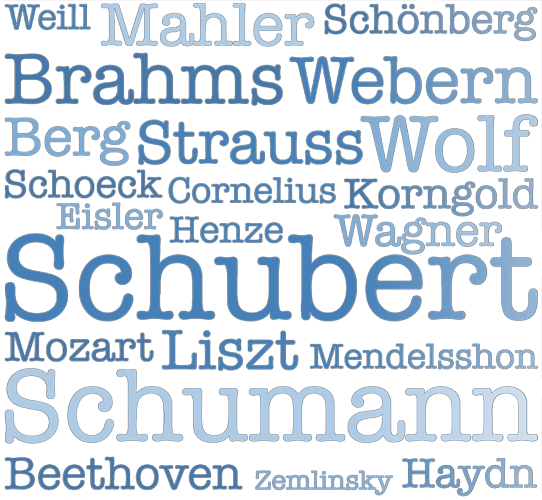


I had never stopped to count how many composers are performed at a Schubertíada. This year I went through the programme, and in the lied recitals there will be twenty eight of them (and if we add the chamber concerts, thirty four). Quite a variety, right? Shall we go through them?
The most frequently performed composer, of course, is Franz Schubert. There will be two concerts featuring only his music. The first will take place in Pals, where Mikhail Timoshenko (attention, lots of attention to this baritone) and Elitsa Desseva, a duo making their Schubertíada debut this year, will perform Winterreise.
The second, in Vilabertran, will be given by Samuel Hasselhorn and Ammiel Bushakevitz, who continue their Schubert 200 project, this time with a programme devoted to works composed in 1826. I still have a very vivid memory of last year’s wonderful concert; all I can say is: don’t miss this one.
There will also be Schubert in the opening concert, throughout the entire first half (with much loved lieder such as Nacht und Träume, Der Jüngling an der Quelle or Rastlose Liebe). The second half of the recital, given by the Swedish duo of soprano Matilda Sterby and pianist Matti Hirvonen, will be devoted to three other composers: the Norwegian Edvard Grieg, the Finnish Jean Sibelius, and the Swedish Gösta Nystroem, the least known of the three, whom I’ve already noted down to write about in another article, because his songs are beautiful.
Let’s stay with Schubert, because Johannes Martin Kränzle (a return that makes me very happy) and Hilko Dumno have also included him in their programme, alongside two other composers: the Swiss Frank Martin, with the Sechs Monologe aus “Jedermann”, and Gustav Mahler, whose Kindertotenlieder and a selection from Des Knaben Wunderhorn we will hear.
And finally, there will be Schubert (or so we assume, it’s tradition) in the two Academy concerts: Wolfgang Holzmair’s, with the duos formed by Katharina Bierweiler and Jyri Mishukov, and by Marta Esteban and Adrià Crespo; and the Academy led by Olaf Bär and Wolfram Rieger, with three duos: Alba Valdivieso and Carlos Bujosa; Jasperina Verheij and Willem van den Dool; and Klara Brockhaus and Rodolfo Focarelli.
With the king of the house duly acknowledged, the other major figure of this year’s Schubertíada will be Johannes Brahms, with two concerts. The first brings together Andrè Schuen, Daniel Heide and actor Pere Arquillué to perform Die schöne Magelone, the beautiful cycle that tells the love story of Peter, Count of Provence, and Magelone, Princess of Naples. A complicated story, but with a happy ending.
The second Brahms concert will revolve around his Liebesliederwalzer. We’ll hear the first set, a selection from the second, and other works of his that will surely send us out dancing and smiling, thanks to the sextet gathered for the occasion: Elionor Martínez, Marie Seidler, Santiago Sánchez, Henk Neven, Pauliina Tukiainen and Victoria Guerrero.
What about the other great composers of the repertoire? You may remember that around this time last year I was lamenting that we wouldn’t hear either Schumann or Wolf in Vilabertran. As for Wolf, we still won’t hear him (artists, why?!), but from Robert Schumann we will have a magnificent work: the Liederkreis on poems by Eichendorff, in the recital by Erika Baikoff and Roman Borisov. Pay close attention to this programme, because it will also include Beethoven’s An die ferne Geliebte (I don’t recall ever hearing it sung by a woman), Samuel Barber’s Hermit Songs —regular readers know he’s a composer I adore—, a selection of songs by Sergei Rachmaninoff, and finally a selection by his friend Nikolai Medtner, a very interesting composer who is rarely heard in recitals.
Schumann’s lieder will also be heard in the final concert of the Schubertíada. And you may be thinking: isn’t the closing concert usually given by the Casals Quartet? Yes, and this year as well, but they will be joined by soprano Juliane Banse, and together they will perform the six lieder of Op. 107 (including the marvellous Abendlied) in Aribert Reimann’s version for soprano and string quartet.
Continuing with the big names, we will have Richard Strauss on two occasions. The first, with Marta Bauzà and Jesús López Blanco in Vilajuïga. The focus of this concert will be the Mallorcan composer Miquel Capllonch, who, during the more than twenty years he lived in Germany, connected deeply with the post Romantic spirit of the time; alongside his own lieder, we will hear works by other composers he was associated with during those years, such as Clara Schumann, Heinrich von Herzogenberg, Max Reger, Hans Pfitzner and the aforementioned Strauss. It will be a wonderful lesson in musical history and a perfect concert for curious listeners who enjoy discovering new works and composers.
Strauss’s lieder (including the gorgeous Befreit and Cäcilie) will also be heard in the voice of Ruzan Mantashyan, who returns to Vilabertran accompanied this time by Armenian pianist Margarit Sargsyan. This concert will also include Komitas (how he captivated us last year!), Antonín Dvořák with his Love Songs, and Pyotr Ilyich Tchaikovsky.
Eduard Toldrà and Frederic Mompou will be the pillars of the concert by Mireia Tarragó and Wolfram Rieger. Each composer will head one half of the programme, and their music will be followed by works by other composers with a similar atmosphere. Thus, after Combat del somni we will hear songs by Dora Pejačević and Claude Debussy, and after La rosa als llavis, songs by Francis Poulenc and Arnold Schönberg.
And with this concert we should have twenty eight names in bold, if I haven’t forgotten to mark any.
Fans of Matthias Goerne (there are many of us, the fans of Matthias Goerne) may be wondering whether he’s not coming to Vilabertran this August. Oh yes, he is! And with a programme we don’t yet know, but which will surely be deeply moving. This year’s Schubertíada will be dedicated to the memory of the much loved Jordi Roch, and Goerne has chosen to prepare his programme, from top to bottom, in his honour.
As I always tell you, go through the programme with your diary in hand at schubertiada.cat, and don’t overlook the chamber music concerts.
Shall we add a little music to all these words? How about one of the songs from La rosa als llavis by Toldrà and Joan Salvat Papasseit? I suggest we listen to Seré a ta cambra, amiga [I’ll be in your room, my friend]the fifth song, performed by Lluís Vilamajó and Francisco Poyato.
Shall we see each other at the Schubertíada?
que ningú no ho sabrá.
Cupidell a la porta, m’obrirà
i tancarà.
Entremaliat i destre, serà Ell qui et
prendrà,
i si Tu ets temorosa
no et deixarà cridar.
and nobody will know.
Cupid at the door, will open
and close.
Naughty and deft, he shall
take you,
and if you are fearful
he will not let you scream.
(translation by Salvador Pila)