

In the 1950s, the Romanian poet Paul Celan had settled in Paris, fleeing the Communist regime. He had not been able to flee Nazism, and had been confined, together with his parents, in the Chernivtsi ghetto. Without being able to do anything to prevent it, his parents were transferred to a concentration camp, where they were killed; he survived after passing through several camps himself. His life in peacetime was not easy either. He was hospitalised several times in psychiatric institutions, and took his own life in 1970.
In 1959 he published the collection Sprachgitter [Speech-Grille], which included the poem Tenebrae, of a devastating desolation. The verses place us within the Passion of Christ — Tenebrae is present in the Jewish tradition too, though naturally from a different perspective — ; Christ is abandoned, as is the poetic voice — representing so many other tortured voices — and the roles have been reversed: it is Christ who must pray to men.
A couple of years before the poems were published, at a meeting in Paris, the poet asked the composer Aribert Reimann to set Tenebrae to music. Reimann, who had already set other Celan poems before, was hesitant. In some sense, he felt that this poem should remain as it was: a poem, without any further interference. Until he met Dietrich Fischer-Dieskau, with whom he was not only a regular collaborator but a friend for decades.
In November 1959, Reimann composed Tenebrae, and over the following months he set four more Celan poems; these are the Fünf Gedichte von Paul Celan, a collection in which Tenebrae occupies the central position. It is a hard poem from which emerges a difficult song; I invite you to listen to it calmly; yet, beauty is not absent. The recording is by Fischer-Dieskau and Reimann, probably from 1969 (they gave the premiere together in 1962).
I wish you a happy Easter!
Nah sind wir, Herr,
nahe und greifbar.
Gegriffen schon, Herr,
ineinander verkrallt, als wär
der Leib eines jeden von uns
dein Leib, Herr.
Bete, Herr,
bete zu uns,
wir sind nah.
Windschief gingen wir hin,
gingen wir hin, uns zu bücken
nach Mulde und Maar.
Zur Tränke gingen wir, Herr.
Es war Blut, es war,
was du vergossen, Herr.
Es glänzte.
Es warf uns dein Bild in die Augen, Herr.
Augen und Mund stehn so offen und leer, Herr.
Wir haben getrunken, Herr.
Das Blut und das Bild, das im Blut war, Herr.
Bete, Herr.
Wir sind nah.
Please follow this link if you need an English translation
Related articles
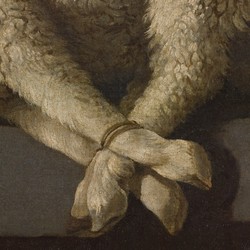
Lamb of God
As I do every year during Easter, I bring you a short text to present a song with a religious theme. This year is a song that is little-known, in every way: it is little performed and little documented. Musicologists have been bringing together the few available pieces of the jigsaw puzzle to reconstruct its history, with many doubts remaining.
Glory’s sun
Between 1912 and 1914, Ralph Vaughan Williams wrote his Four Hymns, in three distinct versions: for tenor, viola, and piano; for viola and string orchestra; and for piano and string quartet. They should have been released in September 1914, but the outbreak of the war prevented it, and they were not performed until 1920. All four songs had texts by four different poets [...]
Lay down his life for his friends
As you might know, I always select a song with a religious subject for these days. Nine years ago, I shared one by Rachmaninoff, Christ has risen, composed in 1906. To set the song for this week, we have to go a few years forward, until a terrible moment in European history: autumn 1914, a few months after the outbreak of the First World War. The most informed Russian [...]