I'm drawn to songs about the sea. Mainly because the sea is an essential part of my landscape. While many people find their greatest pleasure in the mountains (a modern version of waldeinsamkeit) you're far more likely to find me contemplating the sea. Fortunately, close to home. And when I travel, always seeking out other seas wherever I can.
The German repertoire, for obvious geographical reasons, has few references to the sea –one that comes to mind, for example, is a Brahms lied I love, Verzagen. In its place, magnificent rivers unimaginable in our part of the world run through the songs and the landscapes. In the English repertoire, also for obvious geographical reasons, we find beautiful pieces like Elgar's Sea pictures or the far lesser-known songs of Hamilton Harty, such as Sea Wrack. And this week we'll be expanding our maritime repertoire by turning to Sweden.
A few months ago, thanks to Matilda Sterby and Matti Hirvonen, who will perform a selection of it at the opening concert of the Schubertíada, I discovered the song cycle Sånger vid havet [Songs at sea] by Gösta Nystroem, a composer whose name I knew but little else. And I thought I had to share this interesting find with you.
Every article that talks Nystroem's life, briefly or at length, highlights his passion for the sea. One might think that fondness was shared by many of his fellow countrymen, but in his case it seems to have gone further. Far enough to join Knud Rasmussen and Roald Amundsen on an expedition to the Arctic Ocean in 1916 (he was twenty-six at the time), and to sail around Africa by ship in 1928.
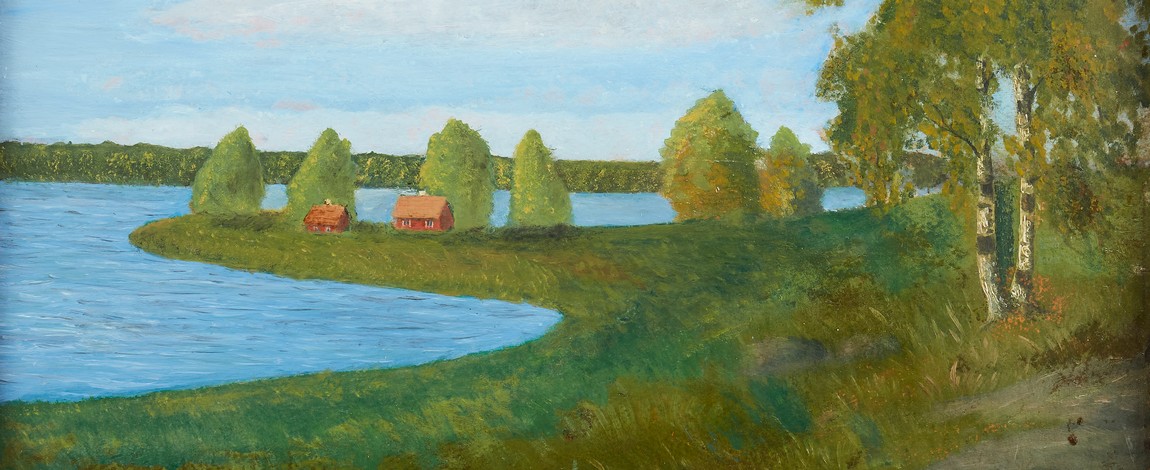
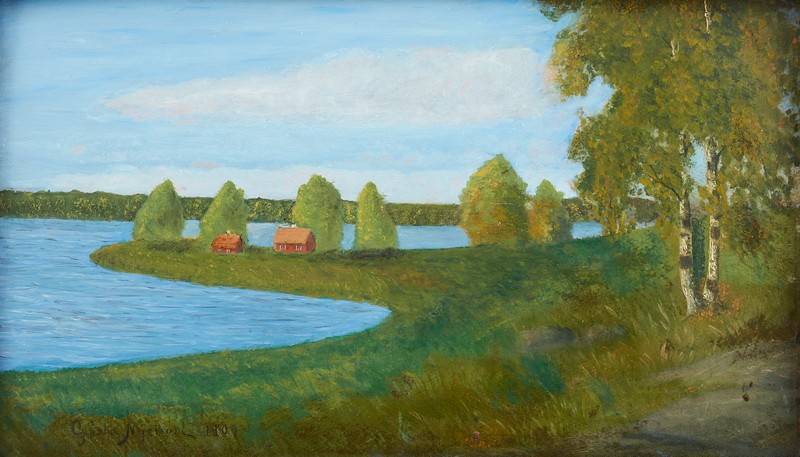
Needless to say, both journeys had a profound influence on his musical output, but we should add that they also influenced his paintings. Nystroem had grown up in a family where music was very present; his father was an organ teacher and amateur composer, and young Gösta was playing the church organ by the age of twelve. But he was also drawn to painting, and for many years he was torn between the two arts as a profession. Nystroem is considered a representative figure of the first generation of modern composers in Sweden –those who moved away from late Romanticism and began composing around the time of the Great War– but he is also valued as one of the first Swedish Cubist painters, and his works can be seen at both the Gothenburg Museum of Art and the National Museum of Sweden in Stockholm.
Our composer-painter's musical training began in Stockholm, continued in Copenhagen, and included a short stay in Germany, until some friends convinced him that the centre of the world at that moment was Paris. And off he went, staying for twelve years. Every reference I read while preparing this article mentioned this detail, and I kept wondering how it was possible; I don't doubt Paris's charms, or the energy it radiated in the 1920s, but it has no sea. Then I found the answer to the mystery: Nystroem did have an apartment near the Seine, but, by his own account, he spent 75% of his time sailing the Mediterranean or based in Brittany.
He returned to Sweden in 1932 and settled in the Bohuslän region, north of Gothenburg and bordering Norway, which encompasses an archipelago of more than three thousand islands and five thousand islets. (If you're fond of crime fiction, this name — and that of one of its towns, Fjällbacka — may well be familiar.)
The cycle I mentioned at the outset, Songs at sea, was composed in 1942; it consists of five songs with poems by four different poets. I'd like us to listen to the first, Ute i skären [Out in the the skerries], with a poem by Ebba Lindqvist. The two shared a love of the sea, and Nystroem would return to her poems to set them to music in other works. The song opens with an Impressionistic feel, the piano seeming to evoke sunlight sparkling on the water; the left-hand bass notes, however, are dark, as if carrying some hidden meaning. The song grows darker still in the second stanza, and after these three lines we hear the first two again to close. The truth is that every time I listen to it I sense some threatening element I can't quite identify: perhaps the longing is impossible to fulfil, or perhaps it's dangerous (because the sea is). Or perhaps it is the boats stranded on the skerries, speaking in the first person, longing for the sea...
This feeling of being in the presence of a mystery, something ancient, something left unexplained, has come over me before. And although I may never get to the bottom of it, these tend to be songs that also have something hypnotic about them, and I love them. I hope you also enjoy Ute i skären, which we'll hear performed by Birgit Finnilä and Geoffrey Parsons.
En dag skall komma, då vinden står stilla,
då darrgräset sjunger och solen somnat.
Då skall vi fara dit ut till de yttersta öarna.
Ljuskringflutna, hägringslysande,
burna på bränningens skum.
A day will come when the wind is still,
When the quaking grass sings and the sun is asleep.
Then we will go out to the outermost islands.
Bathed in light, bright as a mirage,
borne on the foam of the wave.
Related articles
Seas between the twain
“Why should the voice always be accompanied by the pianoforte? There seem to me great possibilities in voices and instruments in combination.” Ralph Vaughan Williams said so in 1940, when he had not written songs for many years. It appears that the piano was an instrument he wasn't particularly fond, and by the time he had written most of his songs, before the Great War, he had used other instruments or ensembles to accompany [...]
Sea Voyage
My dearest, September begins. Welcome back if you went on holiday last weeks, be patient if you (still) didn't go, you are not alone. The last notes from the Schubertíada remain in my mind, I enjoyed so much! After the last concert, my friends A. and J. told me: "You should explain in your blog that we had a terrific time at the Schubertíada!" They're right, we had a great time; we let ourselves be dragged into the darkest Lieder, we were happy Stendhal Syndrome victims and our dopamine release was really high. You should try it if you never went to Vilabertran.
A sea shanty
Last week we said goodbye until next year to the students of the Master in Lied of the ESMUC, next week we'll start to talk about the recitals of the Schubertíada and in the meantime, I propose a trip by sea that, as you will see, is not a pleasure trip.