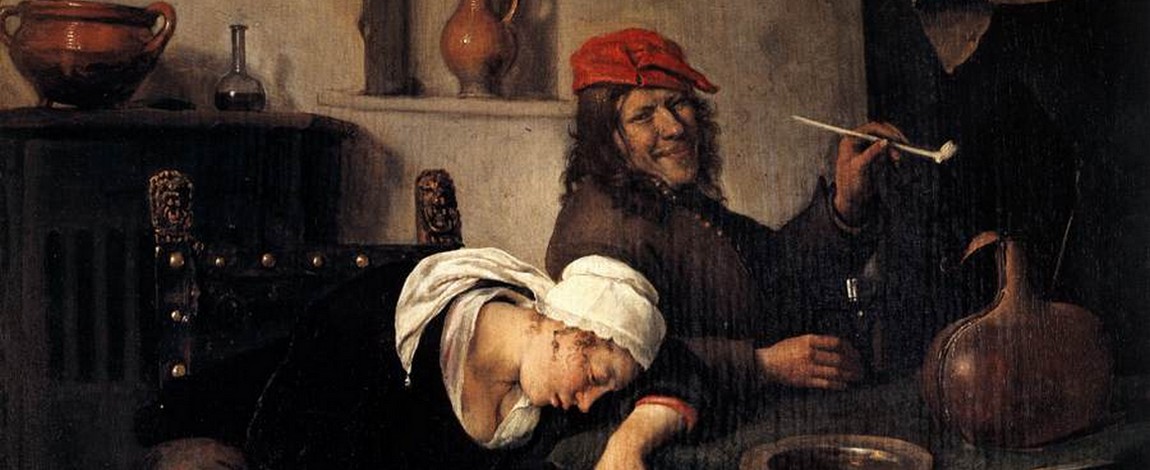

We all have in mind, thanks to cinema –which has presented it in a more or less mythologised way– the image of the writer who creates with the help of alcohol: sitting at the typewriter with a glass of whisky beside him. To complete the scene, cigarettes and an ashtray. What I don’t remember now is the image of the writer creating the next day, as soon as he wakes up, with a hangover that barely lets him open his eyes.
But I often tell you that the lied speaks about life, and that includes both the most transcendent moments and hangovers, the subject of today’s song. Which poet could have chosen such a prosaic topic, and which composer could have set those verses to music and ended up with a wonderful and funny song? Only Eduard Mörike and Hugo Wolf, with their immense humanity and sense of humour.
Mörike’s poem, written in the first person, describes a complicated awakening. Someone drank too much yesterday. And something pushes him to compose a song (or write a poem; depending on the context, as we’ve seen sometimes, the two meanings overlap). So our man does what he must have done many times: he calls on the muse to give him a hand. But the muse must think this is no way to behave, and inspires him with some terribly bad verses. Horrified by what he is writing, the poet soon finds the solution to get rid of it: drinking more wine. Before finishing the poem, however, he warns other authors: if you have a hangover, don’t call on the muses!
With these verses, Hugo Wolf composed Zur Warnung [As a warning] a song about which he himself said that “it sounded frightfully strange” and that he “pitied the poor people who would one day have to listen to it.”
The song is strange, without a doubt. We only need to look at the character indication at the top of the score, “schleichend und trübe”, which would be something like “creeping and bleary”. The song begins with a piano introduction much longer than is usual in Wolf, illustrating how our protagonist wakes up, disoriented and feeling awful.
Even stranger is the instruction to the singer in the first lines: “mit hohler, heiserer Stimme”. More or less, “with a hollow, hoarse voice.” Appropriate for the context? Yes. Complicated for singers? Also yes. I’ve been listening to several versions of Zur Warnung –I must say I had a great time– and I finally chose to share with you the one by Siegfried Lorenz (with Norman Schetler), because I loved the way he begins. You know when someone is hoarse and, somehow, they make you feel hoarse too? Well, Lorenz does that to me.
The poet’s muted voice becomes indignant when he realises that the muse is making fun of him. Because the song she dictates to him is truly awful. And very funny, like the whole song by Wolf. The banal verses are sung with a lively rhythm, in forte, and with a flurry of piano notes. I don’t even want to think about the poor man’s headache. And amid all that horror, he finds a way to stop it: by drinking more wine, which arrives accompanied by forceful chords. And finally, the moral of the song. Will he himself have learned the lesson?
Zur Warnung is No. 49 of the Mörike-Lieder, out of the fifty-three in the collection, and in this final section of the work it appears alongside other songs with a touch of humour, such as Storchenbotschaft, Bei einer Trauung or Abschied. I will never tire of recommending that you immerse yourselves in the Mörike-Lieder, which are a kind of compendium of human nature, with strengths and weaknesses, everyday moments and intimate reflection, humour and sadness… Don’t listen to them all at once, I really wouldn’t recommend that unless you’re a convinced Wolfian; listen to them slowly, reading the poem carefully, looking for how the music follows the words…
Einmal nach einer lustigen Nacht
War ich am Morgen seltsam aufgewacht:
Durst, Wasserscheu, ungleich Geblüt;
Dabei gerührt und weichlich im Gemüt,
Beinah poetisch, ja, ich bat die Muse um ein Lied.
Sie, mit verstelltem Pathos, spottet' mein,
Gab mir den schnöden Bafel ein:
"Es schlägt eine Nachtigall
Am Wasserfall;
Und ein Vogel ebenfalls,
Der schreibt sich Wendehals,
Johann Jakob Wendehals;
Der tut tanzen
Bei den Pflanzen
Ob bemeldten Wasserfalls --"
So ging es fort; mir wurde immer bänger.
Jetzt sprang ich auf: zum Wein! Der war denn auch mein Retter.
Merkt's euch, ihr tränenreichen Sänger,
Im Katzenjammer ruft man keine Götter!
Once after a merry night
I was oddly awakened one morning:
thirst (but not for water), pounding blood,
feeling disturbed and sentimental;
almost poetically, yes, I begged my Muse for a song.
Pretending pathos, she mocked me,
giving me this contemptible piece of trash:
"A nightingale is singing
by the waterfall;
and another bird as well,
who signs his name Wendehals,
Johann Jakob Wendehals;
who dances
by the plants
of the aforesaid waterfall."
and so it continues, and I grew ever more anxious.
Now I sprang up: wine! That would rescue me!
Mark you well, tearful bards,
when you have a hangover, call upon no gods!
(translation by Emily Ezust)
Related articles
Black roses

There is this recurring question in roses’ and gardening forums: "Where could I find black roses?" And the answer is: "Nowhere". Black roses do not exist. There are some varieties which include the word "black" in their name, but they're dark red; The day a rose grower gets the desired hybrid, they’ll make their fortune! I would say that black roses are so wanted because they don't exist in our gardens, but they do in our imaginary, always related to mystery, occultism, tragedy, sorrow...
The last rose of summer

A few days ago, when I was finishing last week's article on Red Roses and Red Noses, I read a detail about the song that I had missed until then. On the booklet of "My Garden" (the CD from which I extracted the interpretation I shared), Richard Stokes said that Lord Berners' song was clearly a parody of Thomas Moore's song The Last Rose of Summer. I thought first I'd make [...]
The king of Babylon
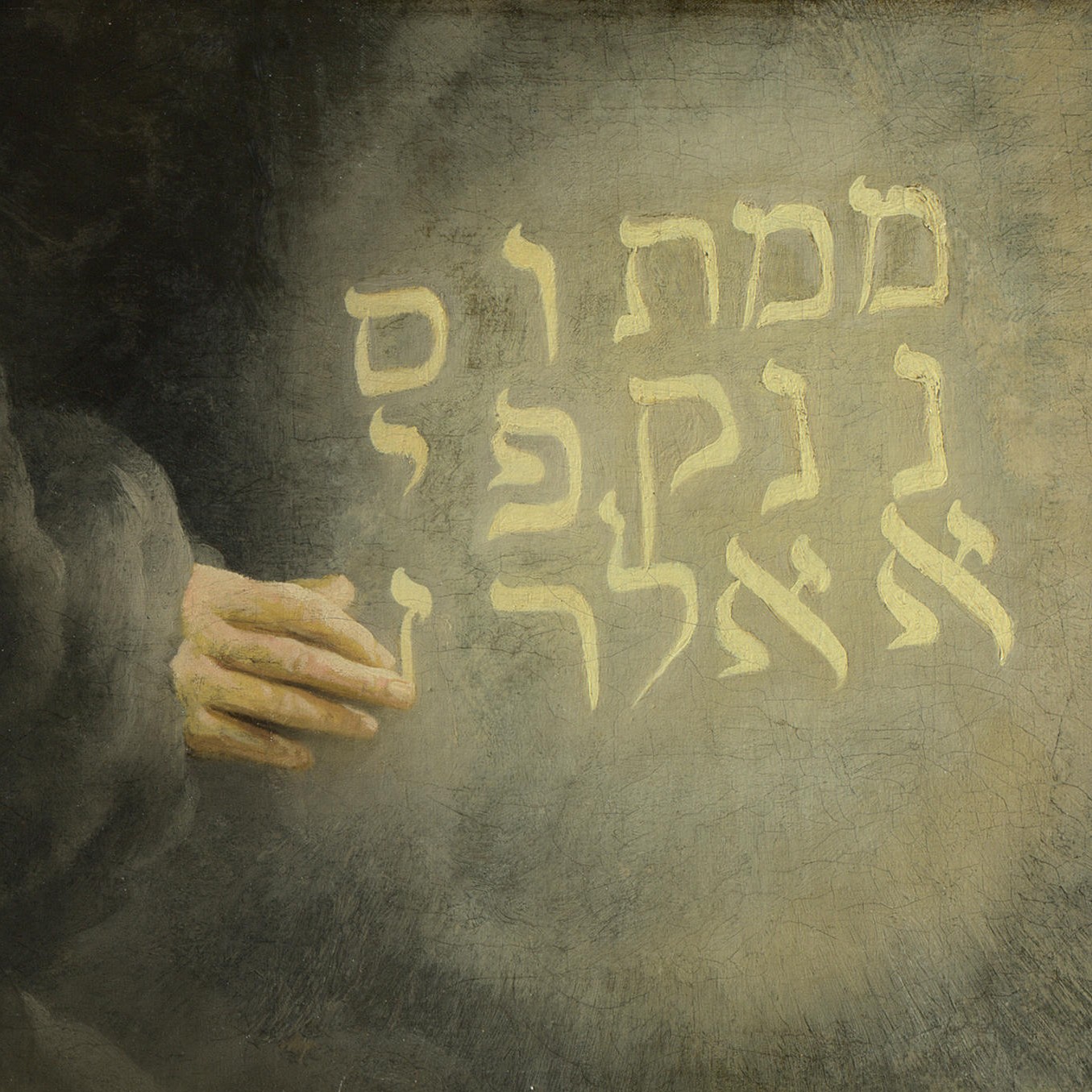
Thus begins chapter 5 of the Book of Daniel in the Old Testament: with a great feast. Besides the king, of course, the thousand lords, their wives and their concubines drink. And you know how these things work: the king talks more than enough, the lords humour him, the situation goes further and Belshazzar ends up by making two mistakes. The first is quite serious: he commands to bring the golden and silver sacred vessels that his father Nebuchadnezzar took from [...]