

I'm not much of a cake or sweets person. When I was a child, I asked my family not to make me a birthday cake because I didn’t like it. And that hasn’t changed to this day. But this week I’d like to invite you all to a birthday cake with fourteen candles, for Liederabend’s fourteen years. Since it’s a virtual cake, everyone can choose the one they like best. Mine will be cheesecake, please.
As I do every year, I’ve gathered the number of songs and of composers, poets, singers and pianists that have been added to our lists over the past twelve months, and that gives us the figures in the title: 754 (songs) – 158 (composers) – 289 (poets) – 302 (singers) – 300 (pianists), which reflect the total accumulated since 2012.
I have to tell you that when I saw the partial numbers, I got a fright: three new composers. “Three? What do you mean, three? Last year there were nine, and the year before that twelve! That can’t be right, you must have made a mistake.” But no, it really is three new composers, no doubt about it. And the rest of the figures follow the same pattern. For example, we’ve listened for the first time to only nine singers, whereas last year there were nineteen.
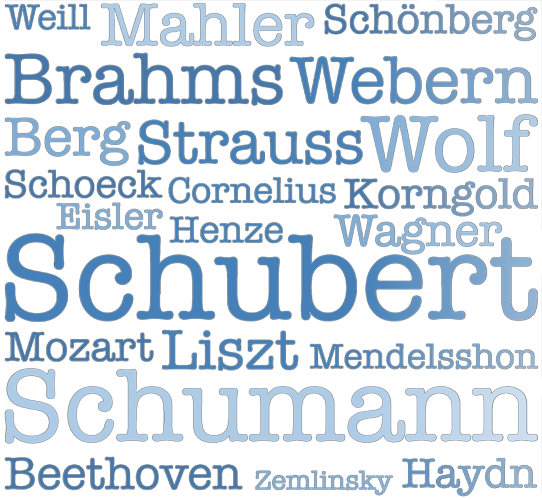
The question I asked myself then was: “But wait, what have you been doing on Liederabend this past year?” For instance, we’ve listened to eleven lieder by Schubert (always the first, and may it never be otherwise); five by Brahms, who usually manages, discreetly, to find his place, and five by Schumann: the two that completed the Dichterliebe cycle and the three parts of Tragödie. We also completed two other cycles: Mahler’s Lieder eines fahrenden Gesellen and Wagner’s Wesendonck-Lieder. If we leave aside the usual suspects and the three new composers, we’ve listened to nineteen others; that is, we’ve revisited many names that are often less heard.
As for the singers, we focused on two centenaries, those of Dietrich Fischer-Dieskau and Nicolai Gedda, with five and four songs respectively – to which we must add the ones we listened to in the first weeks of the year.
But what is truly significant, looking closely at the posts, is that there are eleven from the series The same poem, one more song, a series I started a couple of summers ago, thinking of the July weeks. Since these articles are shorter, because they always refer back to earlier posts, I also publish them when I’m short on time, like I do with the Musical Moments. So yes, there have been eleven of them.
And here we have the answer to the question “But wait, what have you done this past year?” As many of you know, there were major changes at work, and if we add other personal circumstances, I have to say that my life has changed quite a lot. And days still have only twenty-four hours. Not long ago someone asked me how I manage to publish every week on Liederabend, and my answer was “I don’t know.”
How this year will go, we’ll see. For now, to end this article-confession, we’ll listen to a lied by Strauss, whom many of you will have missed in recent months. It will be one of his passionate love songs, Liebeshymnus, with a poem by Karl Henckell – who also wrote the verses of Ich trage meine Minne and the wonderful Ruhe, meine Seele. Strauss composed Liebeshymnus in 1896 and published it as No. 3 of his Op. 32. We’ll listen to it performed by Simon Keenlyside and Malcolm Martineau (because some things never change).
Heil jenem Tag, der dich geboren,
heil ihm, da ich zuerst dich sah!
In deiner Augen Glanz verloren
steh' ich, ein sel'ger Träumer, da.
Mir scheint der Himmel aufzugehn,
den ich von ferne nur geahnt,
und eine Sonne darf ich sehn,
daran die Sehnsucht nur gemahnt.
Wie schön mein Bild in diesem Blicke!
In diesem Blick mein Glück wie groß!
Und flehend ruf' ich zum Geschicke:
O weile, weile, wandellos!
happy was the day I first saw you!
Lost in the radiance of your eyes,
I stand, a blissful dreamer.
Heaven seems to open to me,
yet I only sense it from afar,
and I am permitted to gaze upon the sun,
something my yearning only ever imagined.
How wonderful it is to see my reflection in your eyes!
In your gaze, how great is my happiness!
And I call to my fate imploringly:
"Oh tarry, remain unchanging!"
(translation by Emily Ezust)
Related articles
590 - 134 - 251 - 258 - 249

We spoke a while ago about how trends also affect the world of Lied, and works that had been very much present in recitals and recordings for decades almost disappeared from the repertoire. On that occasion, I shared a Lied that had been one of Schubert's most popular in the 19th century, and now you barely hear it, Lob der Tränen. I would say the Lied of this week [...]
494/119/222/217/216
Another year has passed and this week marks the 9th anniversary of Liederabend. I won't say the year has passed very quickly, on the contrary; it coincided exactly with the pandemic year (just one year ago, the Mobile World Congress in Barcelona was cancelled amid great controversy) and this time has been long, exhausting, sad and confusing. In consequence, Liederabend went through fire and water, like everybody, I guess. I imagine that my posts always reflect my mood, but since this time the mood is collective, who knows, maybe someday we will go through the [...]
439/104/200/197/194
More than one hundred composers. In particular, 104 composers and 439 songs altogether. I must admit that when I checked the numbers for this birthday post, that figure impressed me; I don't think I would be able to list one hundred composers of song if you would ask me now. However, there's another way of set out that: Most composers wrote some songs at some time or other in their careers, so I hope we keep on listening to new composers for a long time, even as unexpected as Bruckner, for instance.