

When we say Italienisches Liederbuch, we think of Hugo Wolf. It makes sense: this collection is probably his best known work —as far as Wolf’s works can be known, you know what I mean. But there is (at least) one other Italienisches Liederbuch in the repertoire: Joseph Marx’s.
Joseph Marx? Why does that name sound familiar?, you may be thinking. Perhaps because his music is occasionally programmed in recitals, and there are several recordings of his works. Or because we’ve spoken about him here at Liederabend before. Or perhaps the name means nothing to you, and today you’ll discover a small sample of his music. To place him briefly, he is one of those composers with a large and high-quality output, highly regarded in his time, whom the new musical trends that prevailed after the Second World War pushed aside. If you want a short introduction, you’ll find a few lines about his career here.
So, back to the beginning: in 1912 Joseph Marx composed his Italienisches Liederbuch, a collection of seventeen lieder, the most extensive he ever wrote. According to the first edition of the score, only one song was earlier, the first one, from 1907.
Why did Marx write this cycle, given that Wolf’s already existed? As listeners, we often feel uneasy when we discover that A, less well-known than B, has composed “the same work” as B. Why does it unsettle us, when we know perfectly well that there is no exclusivity clause in the imaginary contract between poet and composer? And we also know that this multiplicity enriches all of us. Perhaps because it demands an extra effort from us?
Marx wrote this cycle because he found it appropriate. However, if it helps, I can say that in this case we can relax, because he did not choose any of the poems Wolf had set. Was it a deliberate decision? Probably, but it can’t have been very hard to avoid what his predecessor had selected: Paul Heyse’s collection contains three hundred and seventy-five poems, of which Wolf chose only forty-six. Most of them, forty, are rispetti —one of the poetic forms included in the collection— but since there are one hundred and thirty-five in total, it can’t have been much of a problem.
Marx chose seventeen poems that were “new” to listeners; all rispetti except four, two of which are also by Heyse but belong to other collections (they are the first and last songs). I suggest we listen to the ninth song of the cycle, Sendung, which we can translate as “Message”; a beautiful song based on an equally beautiful rispetto, a greeting (in fact, four greetings) sent by the lover to his beloved, who is travelling.
Marx indicated in the score which voice he preferred for each song: nine are for mezzo-soprano, two for baritone, and six for either mezzo or baritone. Even so, the complete recordings of the work that I know are sung by a single voice: either a soprano or a mezzo-soprano (baritones, you have a mission). We will listen to Sendung sung by a mezzosoprano, Angelika Kirchschlager, accompanied by Anthony Spiri. I hope you enjoy it and that it invites you to explore the whole cycle.
Before finishing, just a note: on Thursday, 5 March, the programme of the 34th Schubertíada will be presented, and I will wait until that afternoon to publish the week’s article on Liederabend so that you can be informed right on time.
Als meine vier getreuen Liebesboten.
Der erste pocht an deiner Pforte leise,
Der zweite soll vor dir die Kniee senken,
Der dritte dir die weiße Hand berühren,
Der vierte soll dich bitten, mein zu denken.
As the four loyal messengers of my love.
The first knocks gently upon your gate,
The second is to sink to his knees before you,
The third is to touch your white hand,
The fourth is to beg you to think of me.
(translation by Sharon Krebs)
Articles relacionats
Rispetto
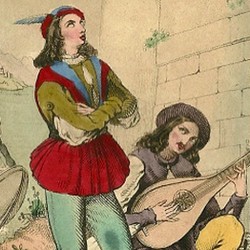
A rispetto is a Tuscan poetic form, usually composed of six or eight hendecasyllabic verses, although the extension may vary between four and ten lines. A Rispetto talks about love, it's a respectful greeting (hence the name) to the loved one. The form spread during the thirteenth century and reached its peak during the second half of the fifteenth century, when it was widely cultivated by Angelo Poliziano and, to a lesser extent, by Lorenzo de' Medici.
Blessed be he

I've been looking back over my notes about the Italienisches Liederbuch by Hugo Wolf these last few days because I'm preparing a talk about this work. And I realized that we had not listened to a song from this work for a long time, almost three years. I'm afraid that it's something that happens to me often, I forget the great works once introduced. It seems that 52 weeks a year are not so many... I can say in my defence that we usually listen to Wolf.
Fugitive heart
Last week we had an Italienisches Liederbuch in Barcelona, and this must be celebrated. Above all, we should celebrate the fact that we can hear Hugo Wolfs collection relatively often and with naturalness. How will it be celebrated? Listening to a song, of course.