- Details
By 1933, Erich Korngold had spent several years mainly working on operettas; making some adaptations in collaboration with the theatre director Max Reinhardt. He was a bit fed up with that because so many trips and rehearsals prevented him from writing his own music. However, on the other hand, it was financially worthwhile; thank to that money, he could get married and, that year, he bought a house in the Alps which became his refuge. That summer, taking advantage of a break between operettas, the composer wrote a song cycle, Unvergänglichkeit, op. 27, with poems of Eleonore van der Straten, which was premiered in Vienna in 1937.
- Details
 Back to normal after three Christmas posts with a guest post by Isabel Villagar. Isabel is singing teacher and author of the blog La brújula del canto, and gives us some guidelines on how to initiate students into song singing. Thanks, Isabel!
- Details
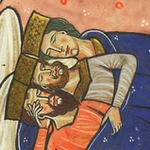
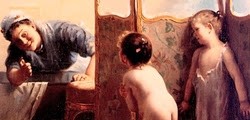
This is the third and last Christmas post of this season (next week we’ll get back back to normal with a guest post) and is dedicated, like the last one, to the Three Holy Kings. They are about to arrive! In my previous post, we celebrated the Epiphany in the German way; A friend told me not long ago that German children still spent that day going from house to house, disguised as the Kings and singing songs. This week we're celebrating in my local style, with the image of children going to bed. Children are extremely excited the eve of the Epiphany, because that night, while they're sleeping, the Kings bring them their gifts; When they get up (very early in the morning, my poor parents!) they'll find out if their wishes came true. As you can imagine, they can hardly fall asleep, as far as they know, if the Kings find them awake, they won't leave any gifts. (I remember covering my head with the bedsheet if I heard footsteps or noise during the night...). So, that night, children need a cradle song more than ever.
- Details
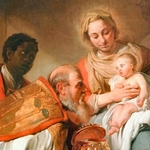
In 1888, Hugo Wolf spent Christmas with the Köcherts: Heinrich, Melanie and their daughters. Melanie's birthday was on Epiphany, and Wolf and the children's gift was a song. To write a song, Wolf needed a poem, of course. He was, at that time, with his Goethe songs (he had written the first one on October, 27th and would write the last one on February, 12th), so it had to be a Goethe's poem. It's a funny poem (that's to say, the serious Johann Wolfgang von Goethe wrote at least two funny poems), a short scene for a party held on Epiphany of 1781. It begins by introducing the three Holy Kings and continues with an individual introduction of Melchior, Gaspar and Balthasar. The Holy Kings are miles away from their traditional solemn image: they love eating and drinking (and not paying for it) and there are quite sensitive to feminine charms. As we know, they're[...]
- Details
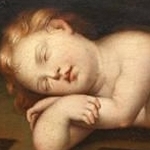 I wonder if you are as much moved as I am with the painting at the top of this post. That Baby Jesus, laying on a cross instead of on a cradle. A tiny cross, custom-made, a quite obvious symbol of what will happen to him some day. These kind of symbols are usual in Baby Jesus' paintings; for example, a goldfinch as a symbol of the crucifixion (it appears in Murillo's "The Holy Family with a little bird" which illustrated a post some years ago) or a pomegranate that symbolises the resurrection. There are usually subtle elements, that could even go unnoticed. But that child sleeping on the cross... even the most clueless observer would grasp the message!
Series