- Details
In November 1775, J. W. von Goethe met Charlotte Stein, a thirty-three years old lady (seven more than him) who was married with six children, and fell in love with her. She also fell for him and an intense love story began, basically, an epistolary relationship. For twelve years they wrote to each other thousands of letters, until one day Goethe went to Italy without telling her a word. She felt terribly hurt by the way he left her and urged him to return all her letters (ladies used to do that to indicate a relationship was finished and gentlemen, in turn, used to do so to prove they didn't want to endanger them); years later, they resumed their relationship, but not as eagerly as the first time. Apart from some 7000 letters written by Goethe (Charlotte destroyed hers), that love story left some reflection on his literary work, as the character of Natalie in Wilhelm Meister's [...]
- Details
Last week, in my post about George Butterworth, I mentioned several times Ralph Vaughan Williams, their friendship and their common interest in folk English music. Their careers were parallel until the war; Vaughan Williams was thirteen years older than Butterworth but started to compose later and their early works came just about together. I just wonder if Butterworth would have been as successful as his friend If he had not died so young.
- Details
 George Orwell says in his essay Inside the Whale (1940): "Among people who were adolescent in the years 1910-25, Housman had an influence which was enormous and is now not at all easy to understand. In 1920, when I was about seventeen, I probably knew the whole of the Shropshire Lad by heart." This quote tells us about the popularity of A Shropshire Lad, a volume of poetry published by Alfred Edward Housman in 1896. Housman didn't consider himself a poet; he was a scholar, a man devoted to research on classical languages. Nevertheless, previous years had been hard for him and he felt compelled to write that poetry collection which talks about loneliness, loss, unhappy love and premature deaths, while evoking an idealized landscape, a kind of [...]
- Details
 Symptoms of baritonophilia are clear. You suffer from baritonophilia when you hear about Pikovaya Dama, you think of Prince Yeletsky, or hear about Die tote Stadt and think of Pierrot; you even think of Riccardo when someone mentions I Puritani. If a tenor sings Pelléas, you complain and you would rename Don Carlo as Posa. If you identify with those symptoms, you should know that it's a quite common disorder (not as much as tenoritis and sopranitis, though) and it's not serious. Just accept it. And enjoy it. And thank Mozart again, this time, because of his Don Giovanni, Leporello, Count Almaviva, Figaro, Guglielmo, Papageno and all of his baritone guys.
- Details
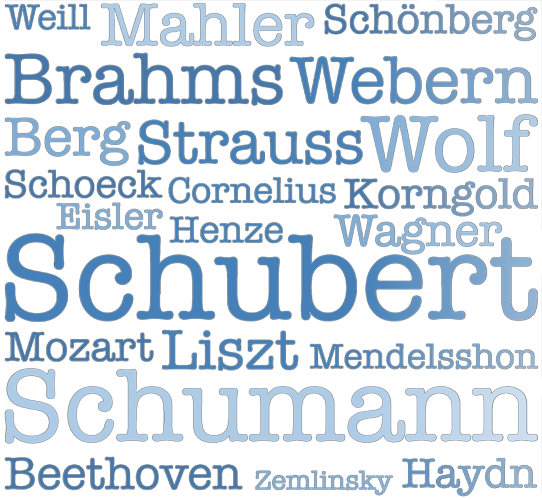
 Today, the Schubertiade Vilabertran 2016, the 24th festival, has been presented. That's why I'm posting later than usual; I wanted to talk about the programme, especially regarding the song recitals. First of all, the dates: the SV16 will take place from 18th August to 3rd September and the format will be arranged as some years ago: the fifteen concerts are concentrated in three long weekends. The first one, from Thursday 18th to Sunday 21st; The second one, longer, from Thursday 25th to Monday 29th and the third one, the shortest, from Thursday 1st to Saturday 3rd. Six song recitals are scheduled; two in the first weekend, four during the second one and one at the third, plus three talks related to three recitals, one each week. This year, the predominance of the German language is overwhelming: Schubert (a lot of him, as you can imagine), Schumann, Brahms, Mendelssohn, [...]
Series