- Details
Song of the week: Nur wer die Sehnsucht kennt (F. Schubert) - A, Kirchschlager, S. Keenlyside, M. Martineau
 We left Wilhelm and his companions at the first chapter in the fourth book, leaving the Count's castle, who provided them the means to get to a nearby village. Once there, Melina organizes the journey to the city where they are settling; Wilhelm forgets about going back home and joins them.
When they are ready to go, some rumours arrive that there are bandits on their road; They have to choose between staying in town some more days, taking a much longer way or just ignoring those rumours and go ahead with their plans. Wilhelm thinks the last one is the best option and soon everybody agrees, especially Melina who thinks is the cheapest option. Nevertheless, they set out ready for an attack.
- Details
Song of the week: Plaisir d'amour (J.P. Martini) - F. Wunderlich, H. Carste (dir.)
 What do Franco Battiato and Elvis Presley have in common? Both did a cover of the same Art Song, a French romance, to be more precise. Other pop singers at some point in their career have also made an incursion into Art Song. This is what this post is about.
We are listening to some versions as sample, but as we have already listened to many of the original songs, I made "a posteriori" list with the related posts. This way you can go over them if you feel like it; I added a comment in every post with a link to the pop version in Youtube. Whenever we talk about other covers, I'll add them to the list; Also, if you happen to know another posted Lied that went Pop, please let me know and [...]
- Details
Song of the week: Poputnaya pesnya (M. Glinka) - G. Nelepp, M. Sakharov
 M. Glinka (lyrics by N.Kukolnik) “Proshaniye s Peterburgom” (“Farewell to Petersburg”), 1840 is a vocal cycle of 12 songs or ”romances” including the most popular themes of romanticism: love and jealousy, beauty of nature, sad remembrances, Oriental exotics and glorifying friendship. The beauty of Russian landscape is reflected in Zhavoronok (The Lark), and passion and jealousy of the lover in Bolero. My Fair Maiden. Mikhail Glinka (1804-1957), the great Russian composer was known for his “romances” (Russian equivalent of Lieder), and Nestor Kukolnik (1809-1869) was one of the most popular poets of the time.
- Details
Song of the week: Le grillon (M. Ravel) - S. Degout, H. Lucas
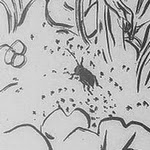 In 1896, Jules Renard published Histoires naturelles (Nature stories), a book of stories whose main characters were animals: hens, turkeys, ducks, cocks, peacocks, pigeons, swans, dogs, cats, cows ... a long list. The book (and the animals’ list) was expanded in later editions until 1909; Renard died the following year. The first story is called Le chasseur d'images (Hunting for Pictures) and explains how someone leaves his house in the morning ready to observe everything he comes across along the day: “les yeux servent de filets où les images s'emprisonnent d'elles-mêmes” (the eyes act as nets where images are trapped). When he returns home, before bedtime, he examines those images. Then, we begin to read descriptions of the images, each one a story; most are short and others, hardly a line.
- Details
Song of the week: Furcht der Geliebten (F. Schubert) - S. Keenlyside, G. Johnson

We get some posts about Schubert every year; he's the apple of my eye. Today, as we did last year and the year before, we are dedicating this post to him, as an homage in his death anniversary, 19th November 1828 (this year, the date happens to meet my posting day). I kept a subject for today, Schubert's “year of miracles”, 1815, during which he wrote 145 songs.
Elisa Rapado gave me the idea some months ago when she blogged about the Annus Mirabilis; she invited singers, pianists and people keen of Schubert to celebrate the 200th anniversary of that year.
Series
The same poem, one more song
The Buch der Lieder and ten composers

The 10 saddest songs

The 10 happiest songs

Ten buggy songs

Wilhelm Meister's Songs

Lied goes pop

Abecedari Liederabend

The ESMUC Master's Degree in Lied visits us