- Details

When Fernando Sor, or Ferran Sors (Barcelona, 1778 – Paris, 1839) first got drawn by the guitar it was no more than a popular instrument, and no serious composers had paid any attention to it. Sor contributed to dignify and introduce it in the concert hall, and that’s why today he is best known as a guitar composer, teacher and player, but his work as a musician is much larger than that and includes operas, ballets and, of course, songs. Like the one in today’s post, one of the “Twelve seguidillas boleras”, composed around 1810.
- Details
 This is the 8th post in the Wilhelm Meister's series, the last of this season; the Goethe's characters will come back in September. Today I'll tell you something that happens while Wilhelm is at the Count's castle, a story about the Count and the Countess. I’m afraid there isn't any song linked to that story, but I'm telling you anyway because it will become important at the end of the novel. Besides, the story is very funny.
- Details
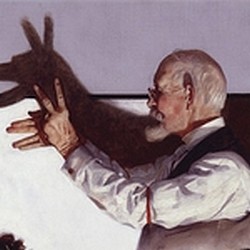
Two boys are at the opera house, waiting for the show to begin. They are so excited that they can't stop moving, talking very fast, whistling... until someone silences them because the curtain rises. This is what the composer, Charles Ives, explains at the first part of his song Memories.
- Details

Small animal prone to be crushed with a slipper.
- Details

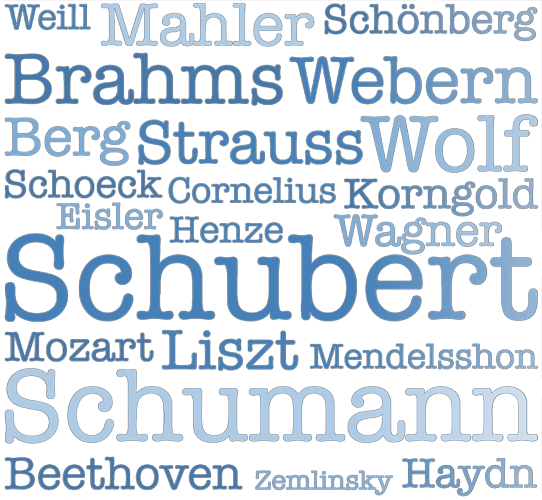
Richard Strauss wrote about 200 Lieder, and only around 50 of them are part of the repertoire; the rest is hardly ever performed. We could say that’s pretty common, a composer’s complete corpus is rare in the repertoire, with the exception of composers such as Mahler and Duparc, who wrote just few songs. Those fifty Lieder are mostly performed with orchestral accompaniment instead of piano accompaniment; that's also normal, Strauss and Mahler fathered orchestral lieder. Some of these famous Lieder were not orchestrated by Strauss but by other composers during his lifetime. I understand that he was aware of that and consented. One last thing: among the Lieder that Strauss composed originally for voice and orchestra, only four are performed on regular basis.

Series