- Details

In 1888, Hugo Wolf spent Christmas with the Köcherts: Heinrich, Melanie and their daughters. Melanie's birthday was on Epiphany, and Wolf and the children's gift was a song. To write a song, Wolf needed a poem, of course. He was, at that time, with his Goethe songs (he had written the first one on October, 27th and would write the last one on February, 12th), so it had to be a Goethe's poem. It's a funny poem (that's to say, the serious Johann Wolfgang von Goethe wrote at least two funny poems), a short scene for a party held on Epiphany of 1781. It begins by introducing the three Holy Kings and continues with an individual introduction of Melchior, Gaspar and Balthasar. The Holy Kings are miles away from their traditional solemn image: they love eating and drinking (and not paying for it) and there are quite sensitive to feminine charms. As we know, they're[...]
- Details
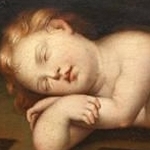 I wonder if you are as much moved as I am with the painting at the top of this post. That Baby Jesus, laying on a cross instead of on a cradle. A tiny cross, custom-made, a quite obvious symbol of what will happen to him some day. These kind of symbols are usual in Baby Jesus' paintings; for example, a goldfinch as a symbol of the crucifixion (it appears in Murillo's "The Holy Family with a little bird" which illustrated a post some years ago) or a pomegranate that symbolises the resurrection. There are usually subtle elements, that could even go unnoticed. But that child sleeping on the cross... even the most clueless observer would grasp the message!
- Details

My friend A keeps asking me to celebrate her birthday with balloons and, in turn, I keep telling her that some day I'll go into a restaurant o wherever we are with a dozen huge balloons, but she doesn’t believe me and neither do I. She's right, I'm not the kind of person who would draw everybody's attention by going into a restaurant with balloons, but that "wherever" could also be here, so, as this week it is her birthday, this week we are going to have balloons. Yes, a song with balloons, thanks to Leonard Bernstein. Don't I always tell you that there's a song for every occasion?
- Details

I love Wolf very much and, however, I don't often talk about him! Maybe I get carried away by his reputation as "difficult", as if we had not heard more “difficult” composers than him. Wolf is so original and so different from his contemporaries and neighbours Brahms and Mahler, not to mention Strauss, that his songs could sound peculiar the first time we listen to them. But, if we insist just a little, the prize is great; the sentence “to know him is to love him” becomes true when talking about Wolf and when talking about the work I'm introducing today (a promise that I made last summer). Because the Italienisches Liederbuch is a wonderful collection of songs.
- Details
 During nearly five years of weekly posts, I have published around forty of them with poems by Goethe. That is, almost a whole year with his verses. These forty songs are composed by eleven different composers, and half of them are from the apple of my eyes (that's to say, Schubert), among them, pearls as Geheimes or Rastlose Liebe. I also dedicated a long series to the songs included in Wilhelm Meister's Apprenticeship, so it's no wonder that the G of Liederabend's alphabet is for Goethe... This letter was one of the easiest.
Series